



How did the Stubbs & Wootton concept come about?
It really began with Percy pursuing something he wanted for himself and his friends to wear. He was in his 30s, working as a banker, and became somewhat obsessed with creating what he considered the perfect Edwardian velvet slipper.
Traditionally, those slippers were very personal. You might have your initials or a family crest embroidered on them. Percy loved that tradition, but naturally, he wanted to have a little more fun with it. He started replacing the expected monograms and crests with things that were more surprising, more personal, and occasionally a little irreverent.
From there, it took on a life of its own. Velvet led to needlepoint, linen, suede, and other materials, and the designs became increasingly varied. People didn’t just buy a pair of Stubbs & Wootton; they began collecting them.

Is there a meaning behind the name?
There is. Percy named Stubbs & Wootton after the English sporting painters George Stubbs and John Wootton, whose work he greatly admired. It’s actually a wonderful clue to understanding Percy and the brand. Their paintings have this incredible refinement and sense of English tradition, but they’re also full of personality, animals, movement, and life. Percy was drawn to that world. He loved tradition, but he was never terribly interested in being constrained by it. I think Stubbs & Wootton has always lived somewhere in that tension. We respect where the slipper came from, and then we allow ourselves to have some fun with it.
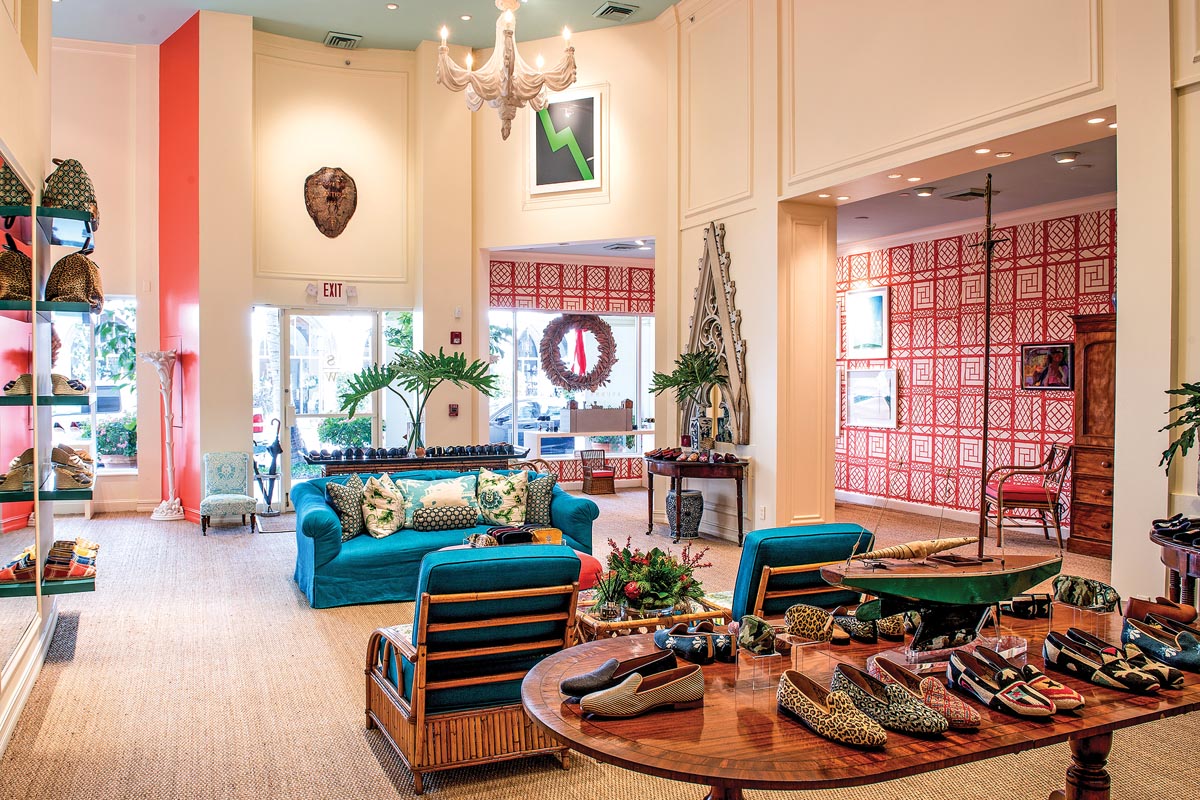
How do you continue to honor the legacy of Percy’s lustrous vision and spirit?
I think the best way to honor Percy is not to try to imitate him. He gave Stubbs & Wootton an extraordinary vocabulary: beautiful materials, wonderful craftsmanship, humor, elegance, and, very importantly, permission not to take elegance too seriously. Our responsibility is to understand that vernacular well enough to continue speaking it in our own way.
We’re also incredibly fortunate that so many of the people who worked alongside Percy are still here. There is an enormous amount of knowledge within this company that isn’t written down anywhere. It’s in the people, the relationships with our creators, the way something is drawn, embroidered, fitted, or finished.
There is continuity, but there also has to be evolution. Percy was far too curious a person to have wanted Stubbs & Wootton frozen in time.
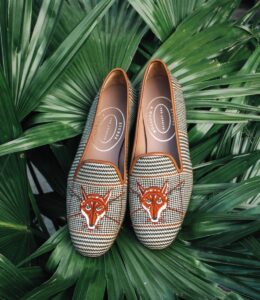
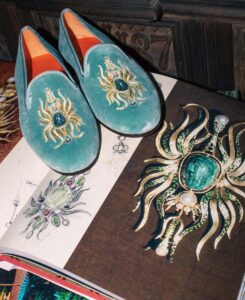
Tell us about the new Archive Collection that will reintroduce Percy’s favorite designs.
The Archive is really our opportunity to open Percy’s closets, so to speak. There are more than three decades of designs in the Stubbs & Wootton vault, and going back through them has been incredibly moving but also great fun. Some immediately transport you to a particular period in Percy’s life, a place he loved, something that amused him, or an idea he became completely obsessed with.
Each quarter we’ll bring back a small selection in limited quantities. For people who have known Stubbs & Wootton for years, we hope they’ll feel like old friends returning. For someone discovering us for the first time, they’re an invitation into the wonderfully particular world Percy began creating in Palm Beach in 1993. And I think Percy would have enjoyed the idea that something he drew 30 years ago could suddenly walk out the door again on a completely new generation.