

A few minutes before 10 on a cloudless morning, people gather in front of the bronze and iron gates to the Flagler Museum, anticipating a glimpse into the glittering private life of one of last century’s wealthiest Americans. But if you’ve already been to the museum and think you’ve seen all it has to offer, this season is guaranteed to convince you it hasn’t been nearly enough.
On the eve of its 125th year, the original Palm Beach mansion wears its stately age with grace. At the same time, a new guard, led by Board of Trustees President Kelly Matthews Hopkins and Director and CEO Amanda Skier, is adopting a fresh take on Whitehall’s heritage and reintroducing the Gilded Age grande dame as a vibrant center of culture. Among the coming attractions are new education and exhibition spaces, a world-class display of jewelry, and a partnership with the popular HBO series The Gilded Age.
“We have the opportunity to turn a beautiful sleeping giant into the reigning queen of Palm Beach,” says museum supporter Mish Tworkowski, founder and designer of Mish Fine Jewelry. “All it needed was to be awoken from its wonderful tropical nap.”
Highlighting the upcoming season is a new $2-million exhibit space that will debut with an opening showstopper that’s already creating buzz. Launching in February, “Gilded Age Jewelry: The Making of Modern Luxury” will feature more than 125 pieces from all over the world and bring international attention to the museum. “This is our coming out party,” says Campbell Mobley, the Flagler Museum’s chief curator.

Back in 1901, when 71-year-old Henry Morrison Flagler broke ground for Whitehall, the Palm Beach winter home he shared with his third wife and new bride, Mary Lily Kenan, he likely knew it would become the jewel in the crown of his legacy. “No homes in South Florida, or in the state for that matter, were as opulent,” says Skier, who joined the museum in February 2025 after serving as the president and CEO of the Preservation Foundation of Palm Beach. “This wasn’t simply a seasonal retreat for him. He saw Palm Beach as the fullest realization of his vision for Florida.”
That vision was born in the late 1800s, when the Standard Oil co-founding partner turned his attention to transforming Florida, beginning with construction of the Florida East Coast Railroad. Stretching from Jacksonville to Key West, the railroad enabled the development of communities like West Palm Beach and Miami and supported Flagler’s string of resort hotels along the coast. Agriculture and tourism, two of the biggest drivers of the state’s economy, can trace their growth to the remarkable infrastructure built by Flagler during the swan song of his brilliant entrepreneurial life.
Today, his legacy is in the hands of his great-great-granddaughter, Kelly Matthews Hopkins, who has been president of the Flagler Museum board of trustees since 2022. Her grandmother, Jean Flagler Matthews, gracefully ushered the home into its current life, establishing a foundation and opening it to the public in 1960. She was the first board president, followed by her son and Hopkins’ father, George Matthews, who served as president for 42 years. Hopkins now wears her birthright with honor and believes her great-great-grandfather would be proud to witness the evolution of both the home and the community he helped create.
“He’s the reason we’re here,” she says. “He built the infrastructure and laid the foundation for what Palm Beach has become today.”

The town’s progression from a wealthy winter resort to one deeply invested in its heritage is a valuable wellspring in Skier’s mission to create a “cultural beacon” for the community. Already well-known in Palm Beach through her leadership of the Preservation Foundation, she approached fellow preservation advocate Tworkowski early on about becoming involved in redefining Whitehall. His initial reaction was skepticism, followed by a dose of humility.
“When Amanda asked me when was the last time I was at the museum, I had to step back and embarrassingly admit it was probably 25 years ago,” he says. “I consider myself a cultured person, yet I hadn’t been inside in so long and, even worse, it was probably because of a wedding. But after being in the museum for 15 minutes, I was overwhelmed by the incredible possibility this house holds. I fully believe this will be the most amazing place in Palm Beach.”
But it takes more than passion to turn vision into reality. It takes money. Whitehall’s annual operating budget of $9.2 million is separate from capital and preservation expenditures. Endowment earnings and philanthropic support from members pay for improvements such as restoring the trusses in the attic, shoring up the basement, replacing parts of the roof, and upgrading the HVAC system, all of which have commenced or been completed in the past year, according to Lawrence L. Gray, CEO of Gray Holdings, a member of the board of trustees building and finance committees, and a great-great-grandnephew of Mary Lily Kenan.
“We have a Beaux Arts mansion built in 1902,” Gray says. “By its very nature it is a constantly deteriorating asset that needs to be tended to.”

That’s not to say the more visible embellishments have been pushed aside. Before Whitehall became a museum, it was a hotel. Gray’s great-grandmother, Louise Clisby Wise Lewis, had inherited the home after her aunt Mary Lily’s death and, in 1925, sold it to developers. The result was Whitehall Hotel, which operated for more than 30 years before it was largely torn down to enter its third life as a museum. Parts of the hotel remain in the museum; this fall, restoration expert Chris Mills will begin uncovering the stenciled Mediterranean Revival ceiling in the hotel addition’s Palm Court.
As the museum’s many layers and past stories are revealed, Skier is coming up with innovative ways to obtain additional philanthropic support. Earlier this year, she created the Whitehall Restoration Council, a donor leadership initiative that engages a cross-section of supporters seeking a sense of ownership in the museum’s vision. Co-chaired by Tworkowski and Freddie Gray, wife of Lawrence Gray, the invitation-only council invites members to become involved in four specific areas: preservation and conservation, exhibitions and collections, education and public programming, and research and scholarship.
“We’re looking for those who can help us dream big and provide the knowledge, connections, and resources needed to help make those dreams possible,” Skier says.
For the upcoming jewelry exhibit, for instance, Tworkowski called upon his contacts, including Carol Woolton, an historian and former jewelry editor of British Vogue, who will serve as guest curator. Details are under wraps for now, but Tworkowski says they’re getting “astounding pieces from all over the world. This will be the best thing to hit Palm Beach.”
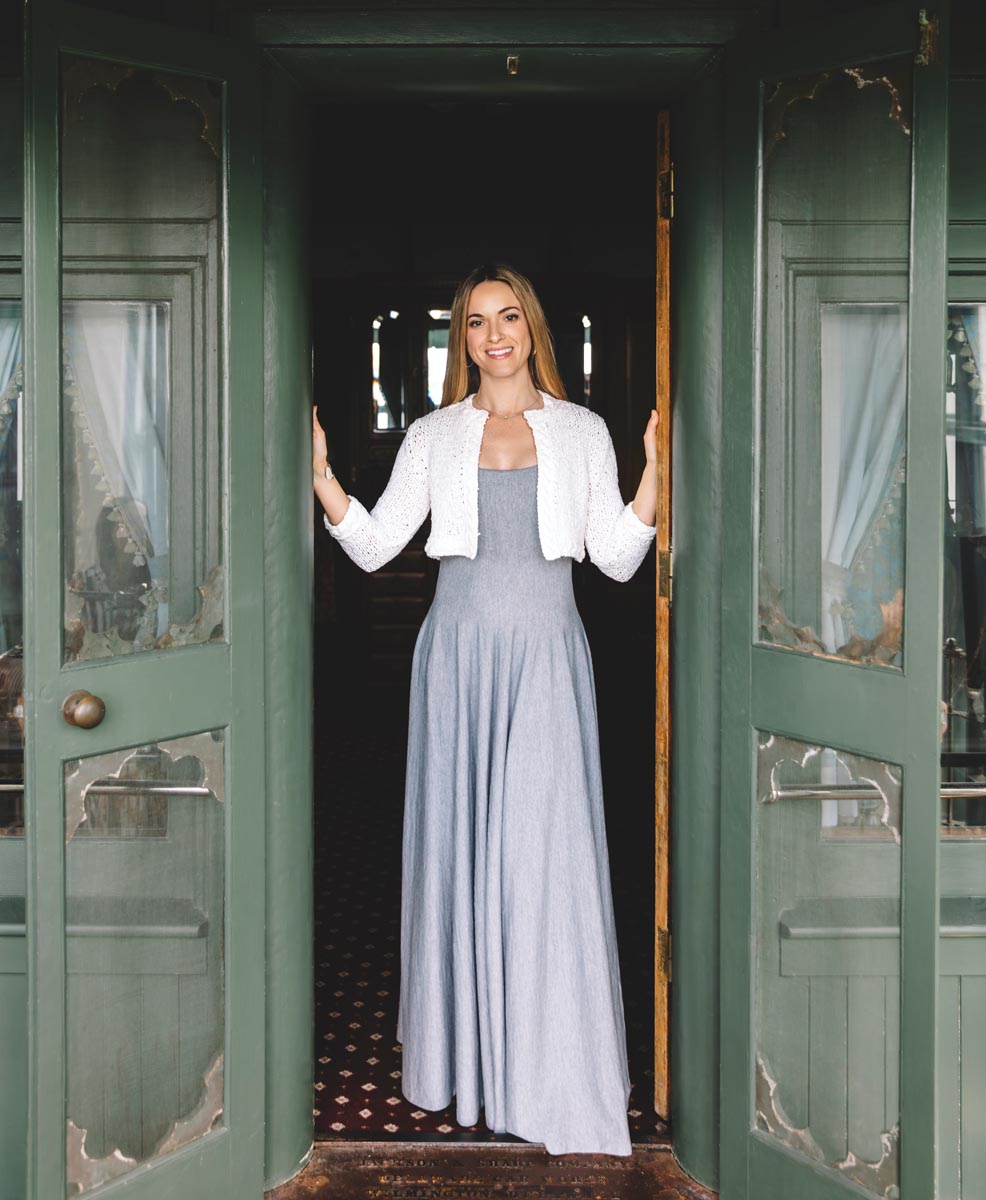
“We know exhibitions drive visitors,” Skier notes. “One of the ways we can invite people to come more frequently is with a variety of programs.”
Following last season’s success with concurrent exhibits in different rooms of the museum, an installation on the 1893 Chicago World’s Fair, “Make No Little Plans: From the White City to Whitehall,” will open in November in two of the upstairs bedrooms and continue its run alongside the jewelry exhibit, explains Mobley. “We try to add balance with a show that can further scholarship and pull from our archives.” Supporting programs and lectures on design, architecture, and innovation will tie the Chicago event with Henry Flagler’s vision for Florida, placing Whitehall within a larger national story of innovation, urban development, and ambition, adds Skier.
In December, the museum is partnering with HBO and Fleurs de Villes for an exhibition of mannequins clothed in artful reproductions of costumes from the show The Gilded Age made entirely of fresh flowers. Jazz on the storied music room’s original Odell organ and a “music walk” that accompanies visitors through various rooms are part of a revamped music series of site-specific performances this season that goes beyond the expected chamber music.
It’s these types of intimate opportunities that are unique to Whitehall and designed to involve the community on a deeper level, say Skier and Mobley. More than a museum, Whitehall is a home that belongs to all of Palm Beach, a place where visitors should have compelling reasons to return, linger, and experience many different aspects of the history of Henry Flagler and Palm Beach.

“We want this home to feel as modern and fresh as it did in 1902,” says Mobley. “We want people to say, ‘No matter what the Flagler Museum does next, I want to see it.’”
The opening of rooms and reimagining of spaces—for musical performances, events, exhibits—is all part of the effort to make the museum accessible to everyone and provide a variety of experiences. Last season, Skier significantly boosted membership, mostly at the entry levels, by reducing the cost of individual and family memberships. She also created a department solely dedicated to education; this season, an education space will open, offering hands-on learning activities for kids. For example, they will be invited to create floral art projects in partnership with The Garden Club of Palm Beach during the “Whitehall in Bloom” Flagler Family Day held on the grounds of Whitehall next April. Additional programming will include arts-and-crafts activities inspired by the White City in the Chicago World’s Fair exhibition as well as interactive experiences connected to the Gilded Age jewelry exhibition.
“We want to be intentional in the message that families are welcome here,” says Skier. “We’re creating areas where kids can be kids within Whitehall.”
At the end of the day, maintaining the museum’s relevance in the community ensures its success for another 125 years. “We’ve been fortunate to come this far, [and] the future will depend on continued community support,” says Hopkins. “Stay tuned. It’s exciting to watch this evolve. We have such a special place, and in many ways, it reflects the Palm Beach we are today.”
Story Credits:
Hair and makeup: Deborah Koepper, Deborah Koepper Beauty, Palm Beach
Amanda Skier’s personal wardrobe: Khaite